Kyoto Cherry Blossom Spots and How to Miss the Worst Crowds
October 27, 2026
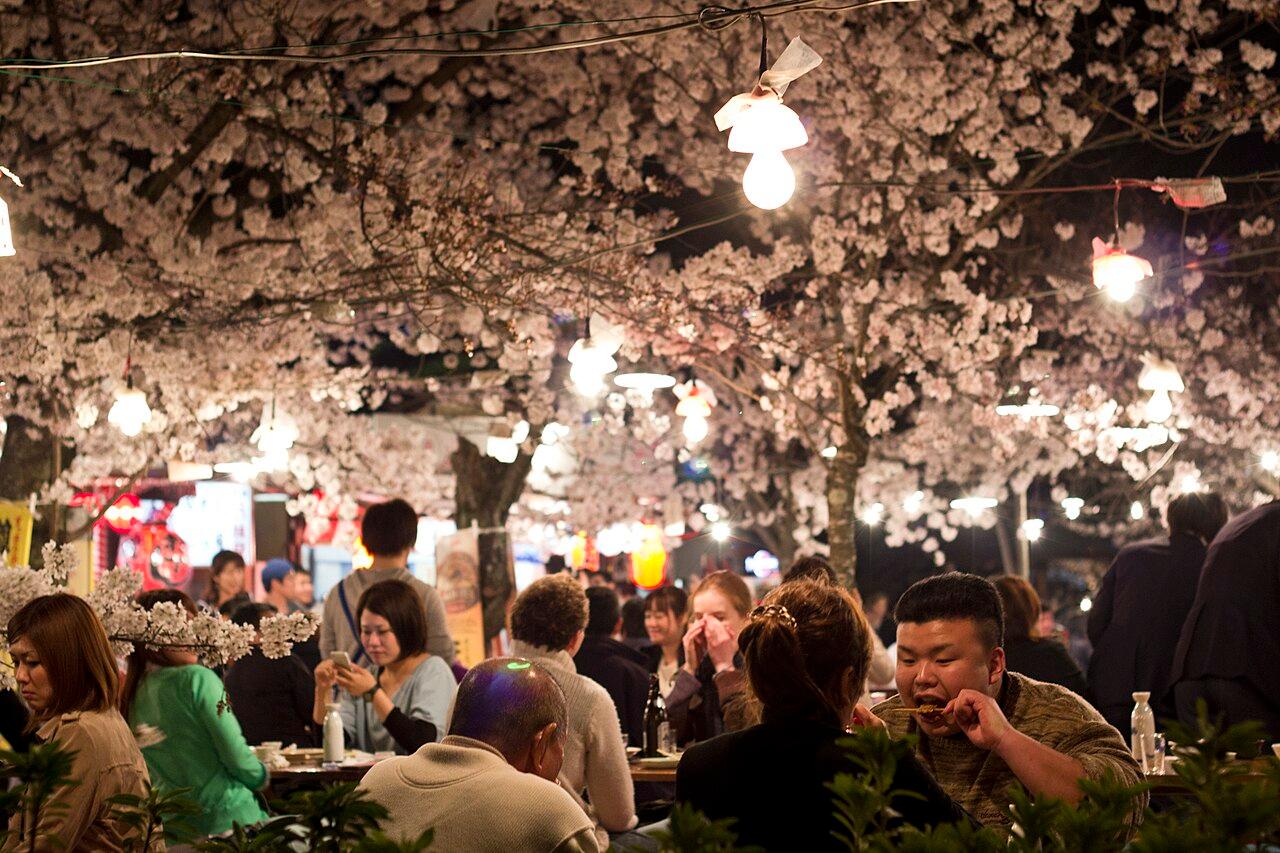
The Kyoto sample tree normally flowers on 26 March and is in full bloom on 4 April, and the famous Kyoto cherry blossom spots are crowded because they sit on paths that were not built for coach parties. They are also close together, and full bloom often lands near a weekend. A secret park does not fix that. Knowing which tree the weather office is actually watching, arriving before the buses, and keeping one indoor backup does.
A 2027 flowering date for those spots is not officially confirmed. The Japan Meteorological Agency records blossom. It does not publish the old public forecast. Private forecasters usually speak in winter. Until they do, plan with the long-term normals and with rooms you can shift by a few days.
What the Kyoto observation actually measures
The Kyoto Local Meteorological Observatory defines flowering as the first day when five or six flowers are open on the sample tree, and full bloom as the first day when about 80 percent of the flowers on that tree are open. The normal, from 1991-2020, is 26 March for flowering and 4 April for full bloom.
The range around that normal is wide. The earliest flowering in the office's table is 16 March 2021. The latest is 9 April 1984. The earliest full bloom is 24 March 2023. The latest is 17 April 1965. In 2026 the sample tree flowered on 23 March and reached full bloom on 30 March. In 2025 those dates were 27 March and 5 April. A trip pinned to "the first Saturday of April" can miss the tree by a week in either direction.
Japan Meteorological Corporation's public news page, checked for this article, still showed its final 2026 forecast (released 23 April 2026), not a 2027 table. In that 2026 release, Kyoto's forecast flowering was 23 March and full bloom 30 March, against an average flowering date of 26 March. Do not reuse those days as a 2027 prediction. The nationwide timing pattern, and how to book before a forecast exists, is in the cherry blossom 2027 Japan guide. This piece stays on Kyoto spots and crowds.
Different species do not follow the sample tree. Kyoto Travel notes that varieties, and elevation, move the local peak. The tree people photograph in Maruyama Park is a weeping cherry, not the Somei Yoshino the observatory uses. It can be at its best on a different day from the headline "Kyoto is at full bloom." Check the park's own photos that week, not only the citywide date.
Kyoto cherry blossom spots, and the hour that matters
Philosopher's Path
The path is a canal-side walk on the east side of the city, between Ginkaku-ji and Nyakuoji Bridge. Kyoto Travel describes it as a stroll past smaller temples, including Honen-in and Anraku-ji, with city-bus access at Ginkaku-ji-mae or Eikan-do-mae. The path itself is a public walk. Ginkaku-ji, at the north end, charges admission. Confirm the current fee on the temple site. The 2027 fee is not restated here.
Crowds build once tour groups reach the Silver Pavilion and walk south. The useful hour is early, from the Ginkaku-ji end, before those groups stack up on the canal. If you arrive at noon, you are in a queue of people taking the same photo. Turn the walk into a one-way: start north, finish south, and do not add a second east-side temple the same morning.
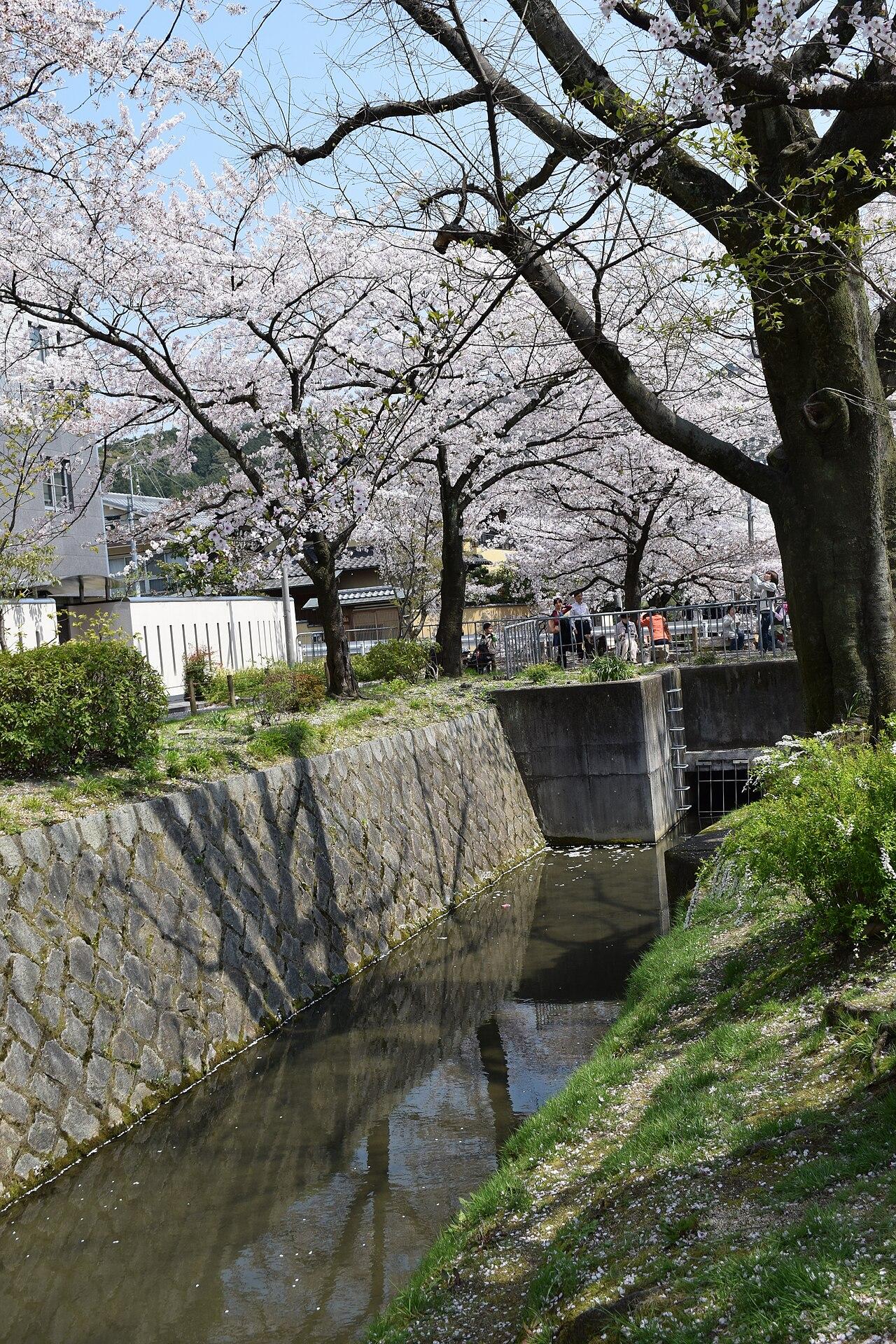
Photo: ::::=UT=:::: / Wikimedia Commons, CC BY-SA 3.0
Maruyama Park
Maruyama Park is the large public park beside Gion, and it is a national scenic place. In 2026 the city lit the weeping cherry from 24 March to 8 April, 18:00 to 22:00. Bonfires were planned from 24 March to 1 April, and cancelled if a dry-air or strong-wind advisory was in force for the city at 16:00. The city also banned saving a spot with tarps. Access that year: city bus 206 to Gion, about 10 minutes on foot from Keihan Gion-Shijo, about 14 minutes from Hankyu Kyoto-Kawaramachi, about 15 minutes from the subway at Higashiyama. The park office number published with that notice is 075-561-1778, 09:00 to 17:00, closed Wednesday.
Those are 2026 arrangements. The 2027 light-up dates, bonfire dates and crowd rules are not officially confirmed. Assume the park will be crowded at full bloom in the evening, because it was built for that, and check the city page in March 2027 before you promise anyone a night photo.
Photo: Japanexperterna.se / Wikimedia Commons, CC BY-SA 3.0
Arashiyama
Togetsukyo crosses the Katsura River with the hills behind it.
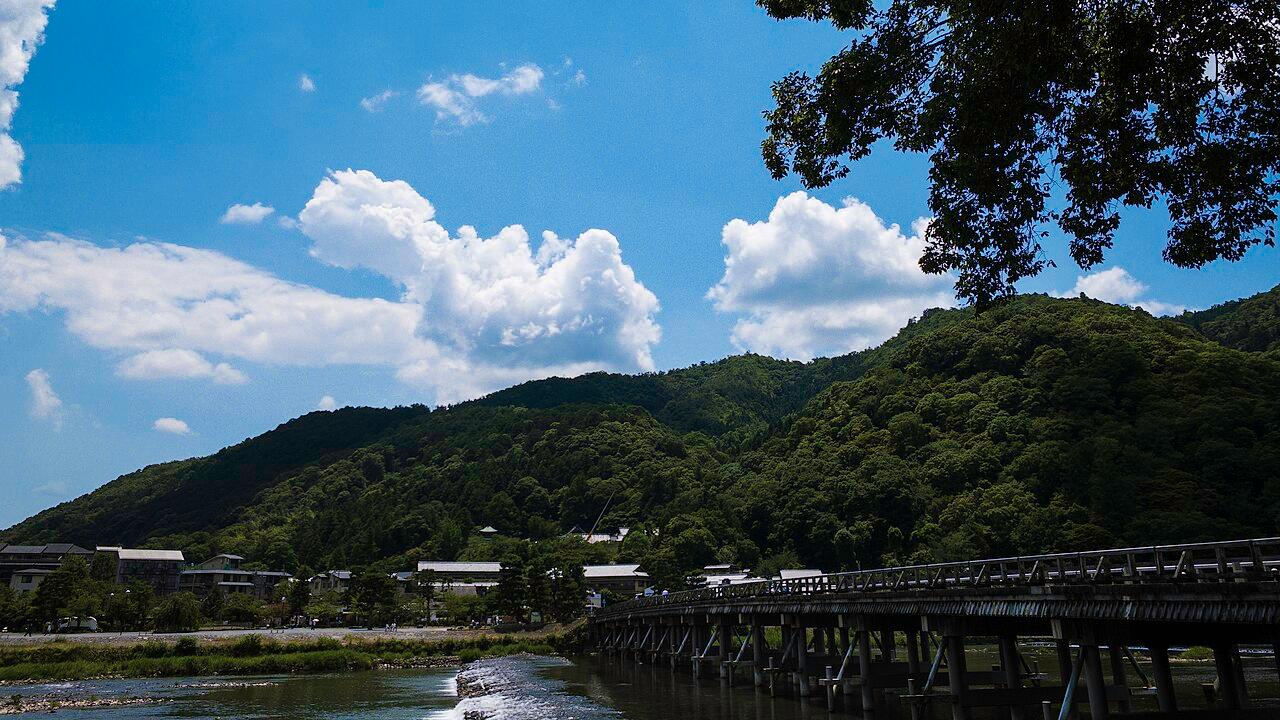
Photo: Rakuten0708 / Wikimedia Commons, CC BY-SA 4.0
The bamboo grove is a short walk from the bridge, which is why the area clogs: two famous things share one path. The practical pattern is to arrive on the first trains to JR Saga-Arashiyama, Hankyu Arashiyama or the Randen line, walk the bridge and the grove, and leave before late morning. Staying for lunch in the main lane is when the pavement stops moving.
There is no official 2027 crowd cap for the grove. It is a path, not a ticketed garden. Your only tool is the clock.
A two-day route that does not stack every famous hour
Use this if Kyoto is your base for the blossom week. It pairs with the 7-day Japan itinerary or the longer 14-day Japan itinerary when Kyoto is one stop among others. Where you sleep matters more here than in a museum city: the Kyoto and Osaka stay comparison is the piece to read before you pick a station. An east-side hotel makes Day 1 a walk. A west-side or station hotel makes Day 2 less painful.
If your dates are still movable, block them in RoamerPlanner as a late-March to early-April window with one spare night, rather than as a single Saturday in Maruyama.
Day 1: East side, early
Morning on the Philosopher's Path, starting at the Ginkaku-ji end. See the temple if the entry line is short. If it is not, stay on the path and visit a smaller temple along it. Afternoon, leave the hills. Nijo Castle is the useful swap: it is ticketed, partly indoors, and it gives you a plan that does not depend on petals. Check the castle's closed day and the current fee before you count on it. Evening at Maruyama Park only if you accept a crowd. If the 2027 light-up is on, go at dusk and do not try to hold ground with a sheet. If you are tired, skip the park. You already walked under trees that morning.
Day 2: Arashiyama, then stop
Morning at Togetsukyo and the bamboo grove, then out. Do not add the monkey park and a river boat and a second temple. Afternoon back toward Kyoto Station or your hotel, with an indoor hour (a museum near the station, or simply a rest) so the day does not depend on a second perfect blossom site. Evening is dinner near where you are sleeping, not a third crossing of the city.
Reserved seats matter if you are leaving Kyoto the next morning for Tokyo or Osaka. The JR Pass article is about whether the pass pays, not about blossom. The blossom-week point is narrower: a seat you hold beats a pass you are still thinking about, on the day everyone else is also riding.
What to do when the weekend is the only weekend
You cannot invent a weekday if your flights are fixed. You can change the order.
- Put the Philosopher's Path at opening on Saturday, not after lunch.
- Put Arashiyama on Sunday at dawn, or accept that you will see the bridge from the edge of a crowd and keep the visit short.
- Use Maruyama at night only if the light-up is confirmed that year. A dark park with no light-up is not the same visit.
- Keep one paid indoor site in the same two days so rain, wind or a petal drop does not empty the plan. Wind and rain end a full bloom faster than the forecast does. The meteorological full-bloom date can be "right" on the sample tree and still be a poor afternoon for a picnic.
Hotel rooms for this window go early. A refundable rate you can slide by three days is worth more than a cheap rate you cannot move when the January forecast, if it comes, shifts Kyoto by a few days. No 2027 room rate is officially set in a way this article can quote. Watch the property, not a rumour of a percentage increase.
Short answers
Which spot is quietest? None of the three above is quiet at full bloom on a weekend afternoon. The Philosopher's Path at opening is the one that still behaves like a walk. Arashiyama at opening is a short visit, not a half day. Maruyama in peak season is a crowd by design.
Does "Kyoto full bloom" mean every garden? No. It means the sample tree, under the 80 percent rule. Weeping cherries and later varieties need their own look.
Are 2027 illumination dates out? Not on the city Maruyama page as checked on 24 October 2026. The 2026 dates above are last season's record.
Is a temple night opening included? Many temples announce special openings in March. Kyoto Travel's blossom calendar for 2026 stopped updating on 10 April 2026 and told readers the next season would be posted later. Treat any 2027 night-opening list you see in autumn 2026 as unofficial until the temple or Kyoto Travel publishes it.
Sources: Kyoto Local Meteorological Observatory, plant-season observations (normals 1991-2020; 2025 and 2026 flowering and full-bloom dates; records; definitions), checked 24 October 2026; Japan Meteorological Corporation, 14th cherry-blossom forecast of 2026, released 23 April 2026 (no 2027 table on that news page at this check); Kyoto City, Maruyama Park weeping-cherry illumination notice, 18 March 2026; Kyoto Travel, Philosopher's Path and the 2026 cherry-blossom calendar (updates ended 10 April 2026). 2027 flowering dates, light-up dates and temple night openings are not officially confirmed.
Cover photo: Japanexperterna.se / Wikimedia Commons, CC BY-SA 3.0
Turn this into a plan
Ready to turn this into a real itinerary? Plan it in RoamerPlanner.
Start your own plan, no account neededBrowse sample trips