Chiang Mai Burning Season: When It Hits and How to Plan
October 27, 2026

March is the worst month for haze in Chiang Mai's 30-year climate record, and May is when it clears. The Chiang Mai burning season is the dry, hot stretch when a mountain view can disappear by late morning. It is not one official festival date but a weather pattern, a set of burning rules, and a health problem that changes from week to week. If your tickets are already bought for February, March or April, you can still plan a useful trip. If you can still move the dates, the climate record tells you which months carry the most haze.
When the Chiang Mai burning season shows up in the climate record
The Thai Meteorological Department's 1991-2020 normals for Chiang Mai station (index 48327) count haze days, rain and temperature together. That is more useful than a single scary afternoon on social media.
Haze days in those normals:
- January: 18.7
- February: 22.1
- March: 26.8
- April: 17.1
- May: 1.5
- December: 13.5
March is the peak in that 30-year set. February is already high. April is lower than March but still far above the wet-season months, which sit near zero. May is the turn. Mean rainfall jumps to 167.5 mm and rainy days to 14.8, and the haze-day count collapses.
Temperature and rain explain why the smoke lingers. March's mean maximum is 35.4°C, the mean is 27.3°C, and the mean minimum is 20.1°C. Mean rain is only 20.4 mm across 2.8 rainy days. Morning visibility at 07:00 averages 6.2 km, the lowest of the year in that table. April is hotter (mean maximum 36.7°C, mean 29.5°C) and a little wetter (54.3 mm, 6.8 rainy days), with morning visibility back up to 8.2 km on the long-term average. These are normals, not a forecast for a named week in 2027. A single year can be cleaner or worse. The shape of the season is stable enough to book against.
December and January are not smoke-free. They are cooler, and they are the months most people mean by the northern cool season. If smoke is the thing you most want to avoid, those months beat March. The trade-off is written up in the Chiang Mai cool-season guide and the wider Thailand in December piece.
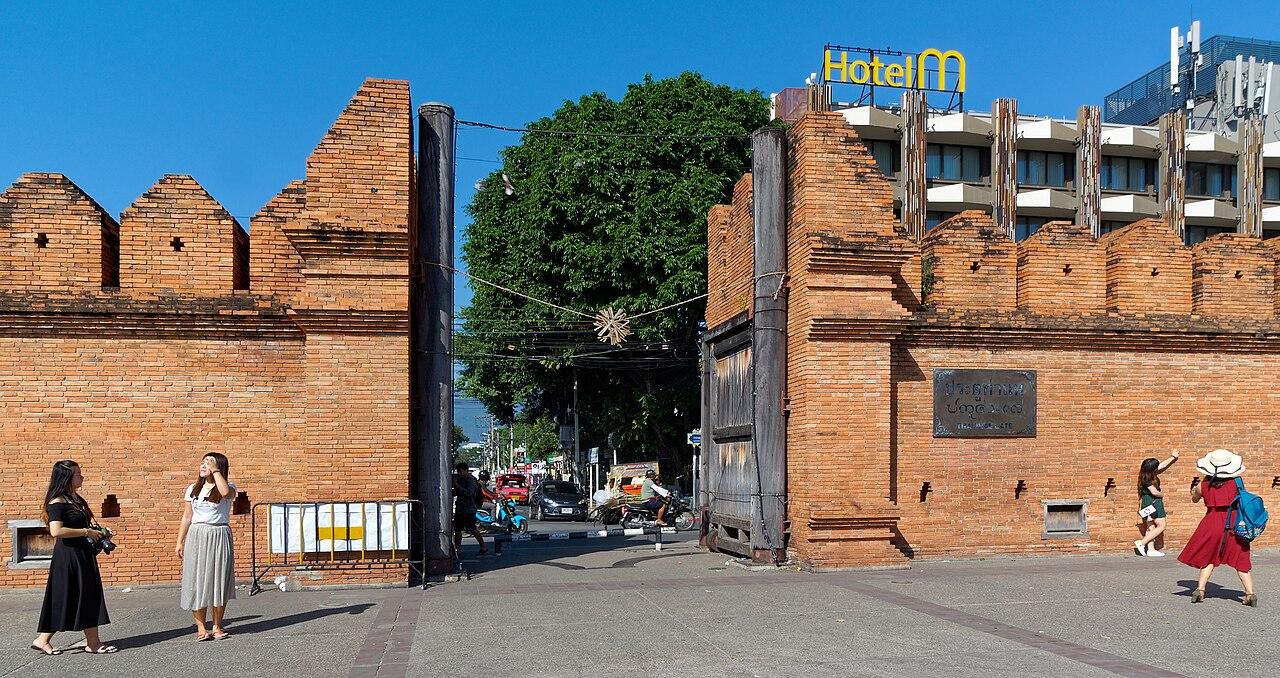
Photo: Jakub Hałun / Wikimedia Commons, CC BY-SA 4.0
What was actually banned, and what is not set for 2027
Two different official layers get mixed up in travel blogs. They are not the same document.
For 2026, Chiang Mai province set a no-open-burning period from 1 January through 31 May 2026. The regional Pollution Control Department office in Chiang Mai reported that window on 5 January 2026, along with measures against forest fire and PM2.5 for that year. A government brief dated 28 January 2026 also described an agricultural no-burn window, for Chiang Mai and three neighbouring provinces, from 1 February to 31 March, with program penalties for farmers who broke it running into 2028. That brief is about the 2026 agricultural season. It is not a published 2027 calendar.
The 2027 provincial no-burn dates are not officially confirmed. Provinces often repeat a January-to-May style ban, but the announcement is a yearly act. Do not print "1 January to 31 May 2027" on a plan until the province or the Pollution Control Department posts it.
Separately, the National Environment Board approved pollution-control-zone status for Chiang Mai, Chiang Rai, Lamphun and Mae Hong Son. The government's English brief of 30 September 2025 confirms the designation and the focus on forest fires, open burning and traffic. Thai PBS, reporting the 8 September 2025 board meeting, gave the northern window as February to May each year (and November to March for Bangkok). If a permit or a fine depends on the exact legal months, read the gazette text, not a retelling.
None of this means the air will be clear inside the ban. A ban is a control on new fires. Smoke already in the valley, fires outside the province, and ordinary traffic still show up in the monitor.
How to read the number on your phone
Thailand's legal line for PM2.5 is a 24-hour average that must not exceed 37.5 micrograms per cubic metre. That standard took effect on 1 June 2023, replacing the older 50 microgram line. The notice is a National Environment Board announcement, carried by the government public-relations system. It is a legal ambient standard. It is not a promise that the city will stay under it, and it is not the same as the World Health Organization's 2021 guideline, which is tighter (15 micrograms per cubic metre as a 24-hour figure).
Check a station, not a headline. Air4Thai, run for the Pollution Control Department, maps more than one point in the province. The foothills and the old city do not always match. Look at the 24-hour average the app is using, and look again in the morning of the day you planned a ridge trip. A pretty dusk photo from a previous year is not a reading.
Provincial health notices are the right source for mask and exercise advice on a bad day. Those notices change with the number. A blog should not invent a personal medical rule on top of them.
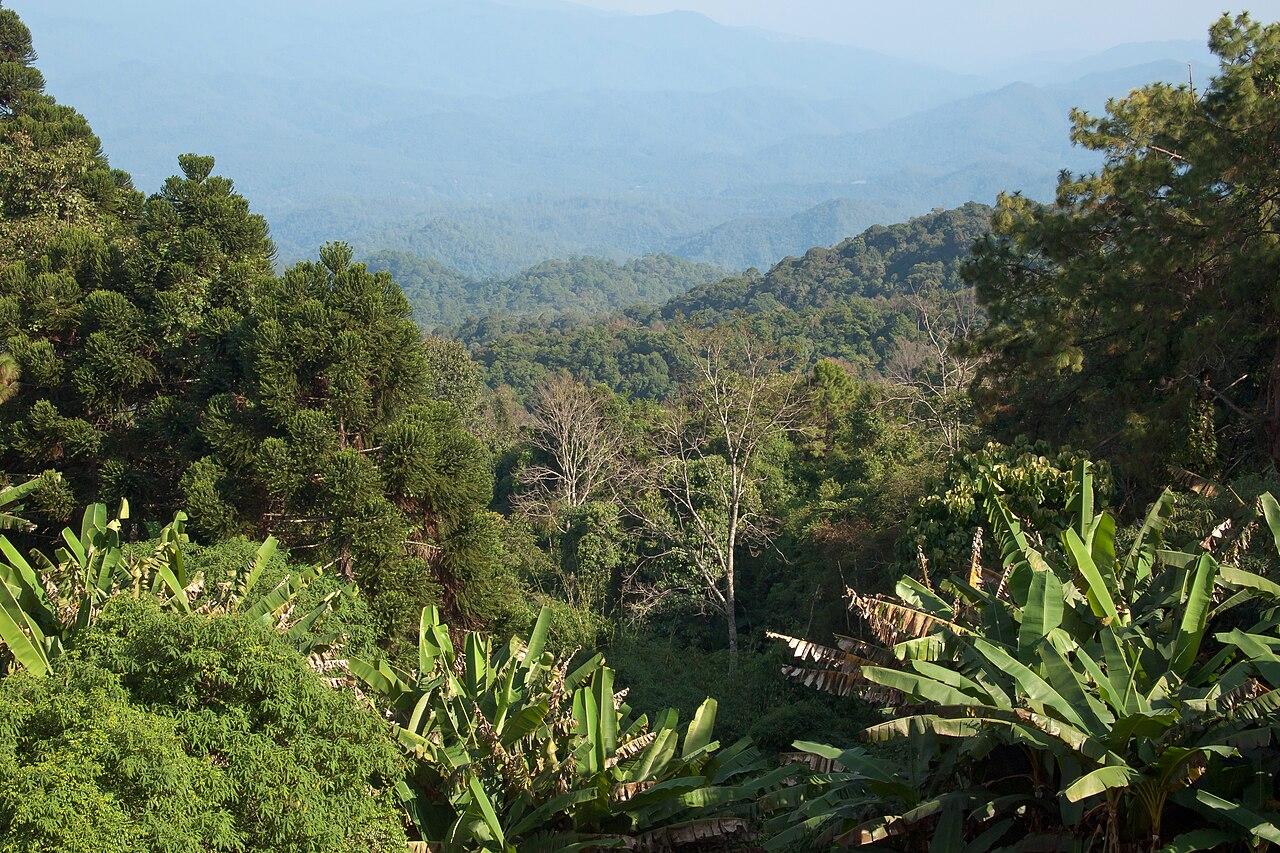
Photo: Vyacheslav Argenberg / Wikimedia Commons, CC BY 4.0
Where to base, and what to drop
The old city, Nimman and the river are all workable in this season because you can cut a day short and go indoors. The difference is how you use them, not a magic clean neighbourhood. Where to stay in Chiang Mai compares those three areas for ordinary trips. In burning season, add one test: can you spend the afternoon inside without wrecking the day?
Drop these if the morning reading is over the standard:
- Doi Suthep as a viewpoint. The temple is still there. The ridge view is the part that fails when visibility is a few kilometres. Go only when that morning's reading and the eye test both look better, and do not make it the only plan on the day you fly out.
- Doi Inthanon or a loop into the hills as a last-morning add-on. Mountain roads plus a flight the same day is a bad pair when the air is thick.
- A sunset viewpoint that is only worth it for the horizon.
Keep temple halls, markets with roofs, and a mall. They are not a consolation prize. They are how a March trip still works.
Getting there does not change with the smoke. Train, flight and bus from Bangkok are compared in Bangkok to Chiang Mai. If you might still shift the month, book the room as refundable and decide the transport once you know if March is staying.
A three-day plan for a trip you cannot move
This is a default for a moderate-to-poor air stretch in the old city. It keeps outdoor time in the morning and puts a roof over the afternoon. If a given morning is clearly better, you can swap one item, noted under the days. A wider old-city shape, without the air constraint, sits in the 3 days in Chiang Mai itinerary. If the numbers that week are awful and you have a choice of city, 3 days in Bangkok is the other short urban plan on the site.
If you are holding two possible date sets, one in March and one in the cool season, put both into RoamerPlanner and mark the ridge visit as the block you are allowed to delete. That is the decision the season actually forces.
Day 1: Old city, then indoors
Morning at Tha Phae Gate and a short walk on the east moat. Keep it to the cooler hour. Afternoon at Wat Chedi Luang, where the courtyard is the outdoor part and the halls are the backup if your eyes sting. Evening in Nimmanhaemin, choosing a cafe or restaurant with a door you can close. Do not add a night market that only works if you stand in the street for two hours.
Day 2: Market, then a mall
Morning at Warorot Market (Kad Luang). The lanes are covered enough for a slow hour, and you can leave when you have had enough. Afternoon at Maya Lifestyle Shopping Center, which is a real indoor block for food, a film or simply sitting in filtered air. Skip a second long outdoor evening. If the afternoon reading has dropped and you feel fine, a short look at the Iron Bridge is the only add-on worth making. If it has not dropped, stay inside.
Day 3: One temple hall, then the airport
Morning at Wat Phra Singh. Afternoon on Ratchadamnoen Road only if you still want a walk; otherwise stay near the hotel. Evening is the airport transfer, with slack in it. Do not insert Doi Suthep on this day unless you have already seen a clear morning and you can be back in the city by early afternoon. The default is to leave the ridge off the last day.
The cover photo of Doi Suthep is what the temple looks like when the air is clear. Treat it as a reference, not as a promise for March.
Questions people ask before they book
Is March always the worst month? In the 1991-2020 haze-day count, yes, March is the highest. A particular March can surprise you in either direction. Use the count to choose a month, then use Air4Thai to choose a day.
Does the burning ban mean the air will be good? No. The 2026 ban limited open burning. It did not switch the valley to the May rainfall pattern. Read the monitor anyway.
Are the 2027 ban dates published? Not as of 24 October 2026. Use the climate normals for planning, and check the provincial announcement closer to the trip.
Should children or anyone with asthma go? That is a medical question for a clinician who knows the person, plus the provincial health notice on the week you travel. The planning fact is simpler: this season asks you to cut outdoor hours, and some trips should move to December or January for that reason alone.
Is Yi Peng in this season? Yi Peng and Loy Krathong fall in the cooler months, not in the March peak. They have their own dates and crowd pattern, covered separately from this air guide.
Sources: Thai Meteorological Department 1991-2020 climatological data for Chiang Mai (station 48327), haze days, temperature, rainfall and 07:00 visibility; Pollution Control Department regional office, Chiang Mai, 5 January 2026 (no-burn period 1 January-31 May 2026); Government Public Relations Department, 28 January 2026 (agricultural no-burn window) and 30 September 2025 (pollution-control zones); Thai PBS, 9 September 2025, on the 8 September 2025 National Environment Board meeting; National Environment Board PM2.5 notice as republished by the government public-relations system (24-hour standard 37.5 µg/m³ from 1 June 2023); WHO global air quality guidelines (2021) for the comparison figure. Checked 24 October 2026. The 2027 no-burn calendar is not officially confirmed.
Cover photo: Philip Nalangan / Wikimedia Commons, CC BY 4.0
Turn this into a plan
Ready to turn this into a real itinerary? Plan it in RoamerPlanner.
Start your own plan, no account neededBrowse sample trips