Vientiane in 2 Days: Is Laos' Capital Worth It Before the Train North?
November 21, 2026
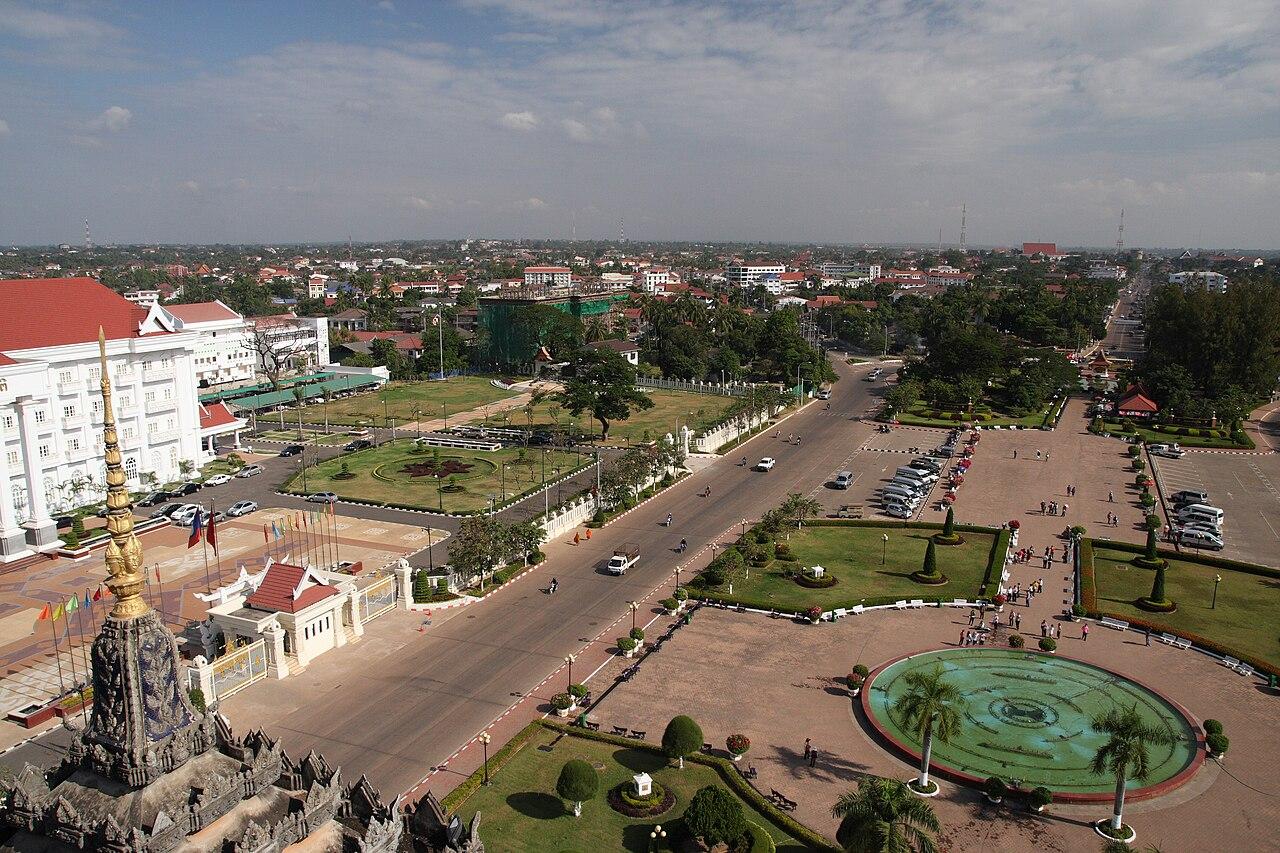
Is Vientiane worth a stop, or should you head straight for the train north? Laos' capital is small and unhurried, and many travellers treat it as a transit point on the way to Vang Vieng and Luang Prabang. Two days is a good amount of time: enough for the golden stupa of Pha That Luang, a couple of old temples, a sobering museum, an evening by the Mekong and some very good food, without feeling rushed. This guide explains what to see, how to plan two days, and how the railway fits in.
If you are visiting in late November, note that the That Luang Festival runs from 20 to 24 November 2026, the biggest religious festival in the country. More on that below.
For a ready-made outline you can copy, see our 2 days in Vientiane sample trip.
Is Vientiane worth visiting?
Yes, if you:
- Like slow cities, temples, cafés and riverside evenings.
- Want to understand more about Laos' recent history before travelling on.
- Are arriving by the overnight train from Bangkok or crossing the Friendship Bridge from Nong Khai and need a base for a night or two anyway.
Maybe not, if you:
- Have only a few days in Laos in total and want nature and old towns. In that case Luang Prabang is the better use of time.
- Are expecting big-city sights. Vientiane is low-rise and quiet for a capital, which is part of its appeal.
Getting to Vientiane
- By air: Wattay International Airport is close to the city centre, usually 15 to 20 minutes by car.
- By train from Thailand: An overnight train runs from Bangkok's Krung Thep Aphiwat station to Khamsavath station on the edge of Vientiane, leaving in the evening and arriving the next morning. You go through border formalities on the way.
- By road from Nong Khai: The first Thai-Lao Friendship Bridge links Nong Khai with the Vientiane side, about 20 kilometres from the city centre. Buses run across from Nong Khai and Udon Thani.
Visas. Many nationalities can get a visa on arrival at Wattay airport and the first Friendship Bridge, or apply in advance for the official Lao eVisa at laoevisa.gov.la. Citizens of most ASEAN countries, including Thailand, do not need a visa for short stays. Fees depend on nationality, and visas on arrival are paid in US dollars cash, so check the rules for your passport before you go.
Day 1: Temples, the arch and the river
Morning: Pha That Luang
Start at Pha That Luang, the gold-covered stupa that is the national symbol of Laos and appears on its seal and banknotes. It stands a few kilometres north-east of the centre, so take a tuk-tuk or a ride-hailing car. Go early, when the gold glows in soft light and it is still cool. There is a small entry fee. Dress respectfully, with shoulders and knees covered. The temples on either side of the stupa are free to look around.
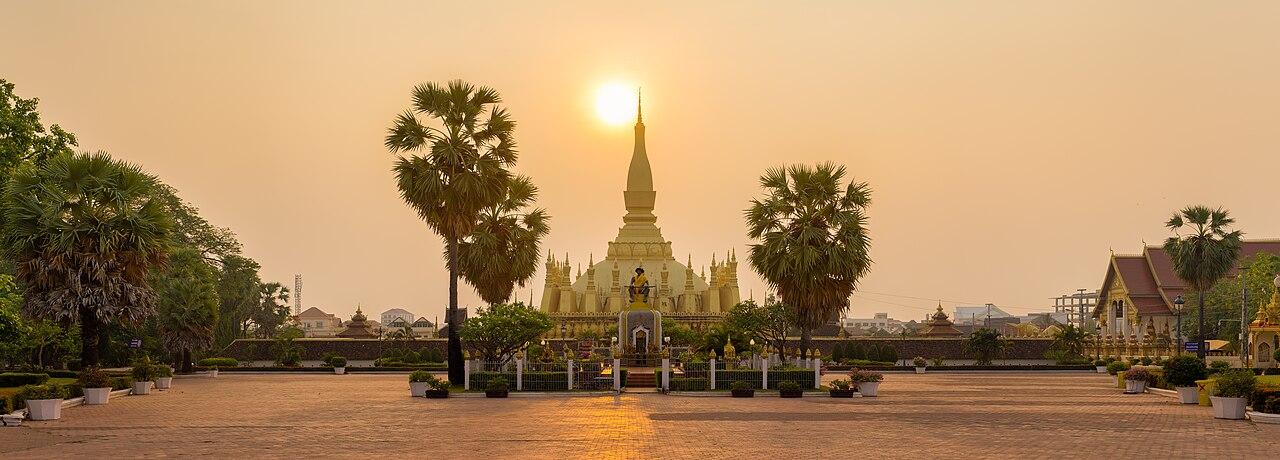
Photo: Benh LIEU SONG (Flickr) / Wikimedia Commons, CC BY-SA 4.0
Late morning: Patuxai
On the way back to the centre, stop at Patuxai, a monumental arch on Lane Xang Avenue. Its design borrows from the Arc de Triomphe in Paris, decorated with Lao motifs. For a small fee you can climb the stairs to the top for a view along the avenue and over the city, past souvenir stalls on the lower floors.
Afternoon: Wat Si Saket and Haw Phra Kaew
After lunch and a break from the heat, visit two sites facing each other near the Presidential Palace:
- Wat Si Saket, built in the early 1800s and one of the oldest surviving temples in the city. Its cloister walls are lined with thousands of small Buddha images.
- Haw Phra Kaew, a former royal temple that once housed the Emerald Buddha, now in Bangkok. Today it is a small museum of religious art.
Both have small entry fees and usually close for the day in the late afternoon.
Evening: The Mekong riverfront
Walk to Chao Anouvong Park on the riverbank for sunset over the Mekong, with Thailand on the far side. A night market sets up along the river in the evening, with clothes, souvenirs and snacks. Then find dinner in the streets just behind the riverfront.
Day 2: History, food and Buddha Park
Morning: COPE Visitor Centre
The COPE Visitor Centre explains the impact of unexploded ordnance left in Laos after the Indochina wars, and the work to help people injured by it. Laos is often described as the most heavily bombed country per person in history. The centre is small, clear and moving, and it gives useful background for the rest of your trip. Entry is free, and donations go to the rehabilitation programme.
Midday: Lao food
Vientiane is a good place to try Lao dishes before heading north:
- Khao piak sen, a thick rice noodle soup, often eaten for breakfast.
- Larb, minced meat or fish salad with herbs and toasted rice.
- Tam mak hoong, the Lao version of green papaya salad, often stronger than the Thai version.
- Khao jee pâté, baguette sandwiches, a legacy of the French period.
- Lao coffee, strong and often served with condensed milk.
The morning market area and the lanes around Nam Phu fountain have plenty of options.
Afternoon: Buddha Park
Buddha Park (Xieng Khuan) is a field of concrete Buddhist and Hindu sculptures built from the late 1950s, about 25 kilometres south-east of the centre near the Friendship Bridge. It includes a huge reclining Buddha and a giant pumpkin-shaped structure you can climb inside. It is a bit strange and quite photogenic. Allow about an hour on site, plus travel time each way. A tuk-tuk or ride-hailing car is easiest; agree a return trip and waiting time with the driver.
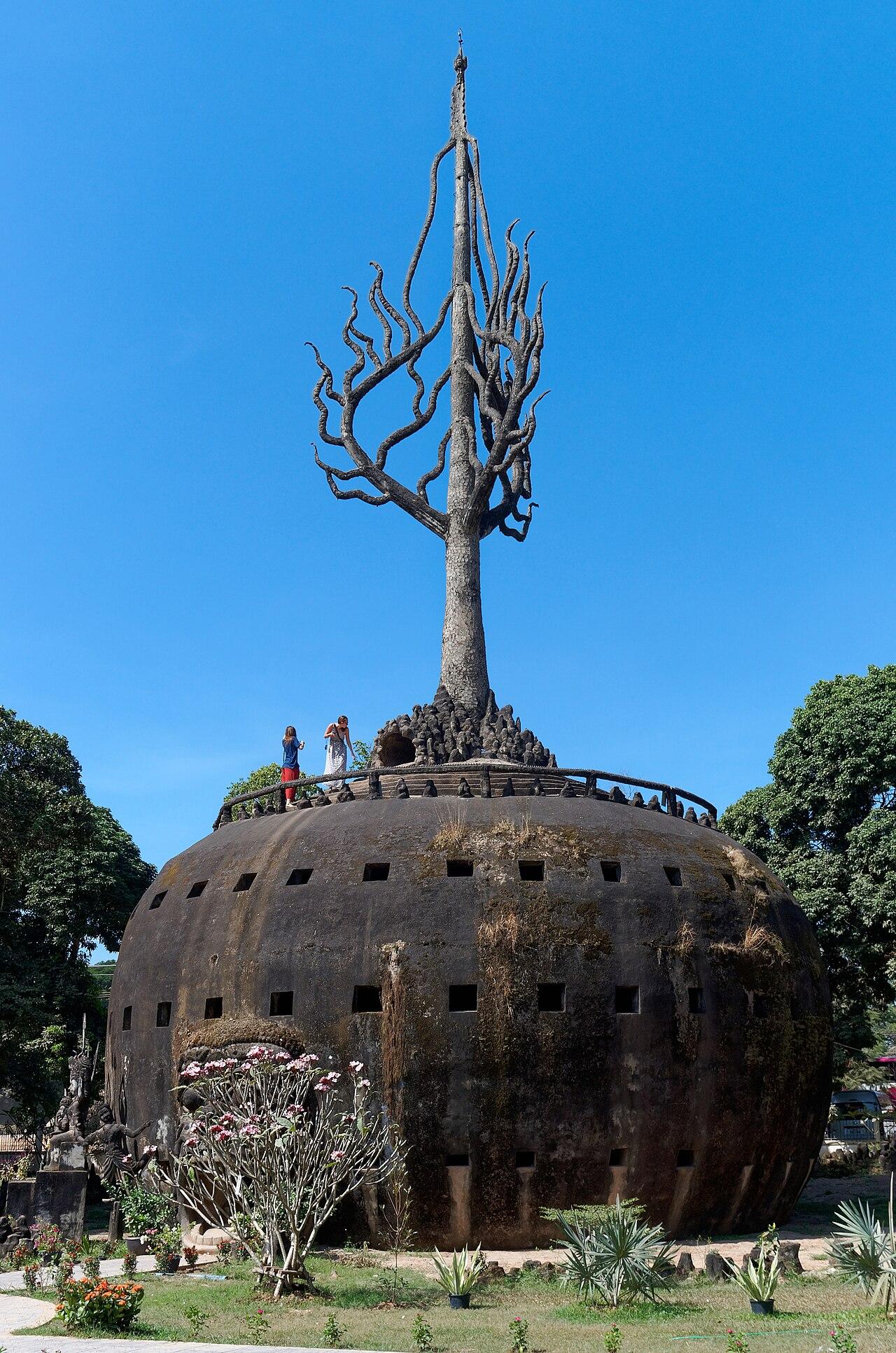
Photo: Jakub Hałun / Wikimedia Commons, CC BY-SA 4.0
Evening
Back in town, have a drink at a riverside bar for the last sunset, or go to a Lao barbecue (sindad) restaurant, where you grill meat and cook vegetables at the table.
That Luang Festival 2026
The That Luang Festival, or Boun That Luang, is held at the full moon of the twelfth lunar month. This year the official programme runs from 20 to 24 November 2026 at the That Luang esplanade, combining Buddhist ceremonies with a large trade fair, concerts and food stalls.
The key events announced by the city:
- 20 November: opening ceremony in the late afternoon.
- 23 November: the wax castle procession from Wat Si Muang to the stupa in the afternoon.
- 24 November (full moon): a large alms-giving ceremony at 7 am, a traditional game of ti khee in the afternoon, and a candlelit procession around the stupa in the evening, ending with fireworks.
If you are in town, the early morning on 24 November is the most meaningful part. Arrive early, dress modestly, and keep a respectful distance from monks and worshippers. Expect traffic and crowds around the stupa and book your hotel ahead.
Taking the train north
The Laos-China Railway has changed travel in Laos. Fast trains from Vientiane reach Vang Vieng in about an hour and Luang Prabang in about two hours, journeys that used to take most of a day by road.
Things to know:
- Vientiane railway station is well outside the city centre, so allow at least half an hour by car and arrive early, as there are security and ticket checks.
- Tickets are sold through the official LCR Ticket app, at the station, and at some ticket offices in town. You need your passport details, and the name must match your passport.
- Tickets often sell out, especially at weekends and holidays. Book as soon as sales open for your date, and have a back-up plan, such as a bus or minivan to Vang Vieng.
For the next stops, see our guide to Luang Prabang in cool season, the 2 days in Vang Vieng and 3 days in Luang Prabang sample trips.
When to visit
The cool, dry season from November to February is the most pleasant time, with warm days and comfortable evenings. March to May is very hot. The rainy season runs roughly from June to October, with heavy showers that usually pass quickly.
Getting around
The centre is easy to walk, especially near the river. For longer rides, use tuk-tuks (agree the price first) or ride-hailing apps that work in Vientiane, such as LOCA. Bicycles can be rented from guesthouses.
Money
The currency is the Lao kip. Prices are often large numbers, so check the zeros carefully. ATMs are common in the centre, and some hotels and tour companies quote in US dollars or Thai baht. Carry kip for markets, tuk-tuks and temple fees.
Planning the rest of Laos
Vientiane often works best as the first or last stop on a route through Laos, or as a link between northeast Thailand and the north of Laos. If you are coming from Thailand, our guide to Thailand in December helps with the Thai part.
To see your train times, festival days and stops in one place, you can lay out the route in RoamerPlanner and adjust it as train tickets come up.
Sources: Lao News Agency (KPL) report of 10 November 2026 on the That Luang Festival programme; Tourism Laos events listing; Lao eVisa official site; State Railway of Thailand timetable for Bangkok to Khamsavath; LCR Ticket app information. Checked 16 November 2026.
Cover photo: yeowatzup / Wikimedia Commons, CC BY 2.0
More about Laos: all articles and trip plans
Trips you can copy
Ready-made day-by-day plans for this place. Copy one for free and change it to fit your trip.
Turn this into a plan
Ready to turn this into a real itinerary? Plan it in RoamerPlanner.
Start your own plan, no account neededBrowse sample trips